
For years, digital advertising has largely revolved around one question: what keyword, audience, or interest should we target?
For years, digital advertising has largely revolved around one question: what keyword, audience, or interest should we target?
Google Ads became powerful because advertisers could reach people searching for specific things. Meta Ads became powerful because advertisers could reach audiences based on interests, behaviours, demographics, and platform signals.
ChatGPT Ads introduces another advertising environment: conversation and context.
Someone doesn't necessarily come to ChatGPT and type "best accounting software." They might say: "I run a small construction company in Dubai with eight employees. I'm currently managing invoices manually and need something simple that my accountant can also access. What should I look for?"
That conversation contains much richer context about what the person is trying to accomplish. This is one of the major differences businesses need to understand about advertising in ChatGPT.
ChatGPT Ads are designed to reach people while they're exploring options, comparing choices and making decisions, and OpenAI says its ad system considers conversational context and intent when determining relevant ads.
So how does ChatGPT advertising actually work? How do you create a campaign? How is targeting different from Google and Meta? What do you pay for? And most importantly, how should businesses approach this new advertising channel? This guide explains the entire process.

What Are ChatGPT Ads?
ChatGPT Ads are paid advertisements that can appear within the ChatGPT experience. But there's an important distinction: advertisements are separate from ChatGPT's answers.
OpenAI states that ads are clearly labelled and appear below responses rather than being secretly inserted into or influencing the answer itself.
A current ChatGPT ad can contain:
Advertiser name
Brand favicon/logo
Headline
Description
Landing page
Image creative
That may sound similar to other advertising platforms. The interesting part is how the advertisement can be matched to the conversation.
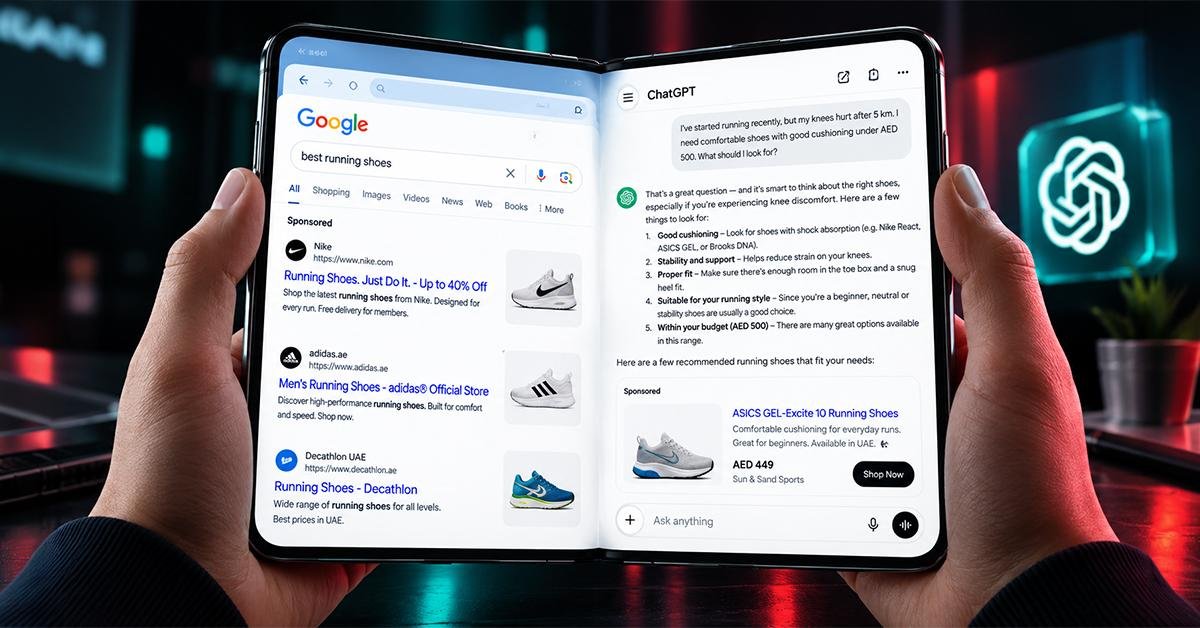
What Makes ChatGPT Ads Different?
This is probably the most important concept for marketers to understand. Traditional advertising platforms frequently depend heavily on relatively structured signals.
Google Search Ads: Keyword → Search → Advertisement
Meta Ads: Audience + behavioural/platform signals → Advertisement
ChatGPT Ads can work more like: Conversation → Context → Intent → Relevant Advertisement
This is a simplified explanation rather than the literal auction algorithm, but it illustrates the strategic difference.
OpenAI says its system can consider signals including the current conversation's context and intent, the advertiser's landing page, title, copy and advertiser-provided context hints. When ad personalization is enabled, select signals from the user's broader ChatGPT experience may also contribute.
That means advertisers need to start thinking beyond individual keywords.
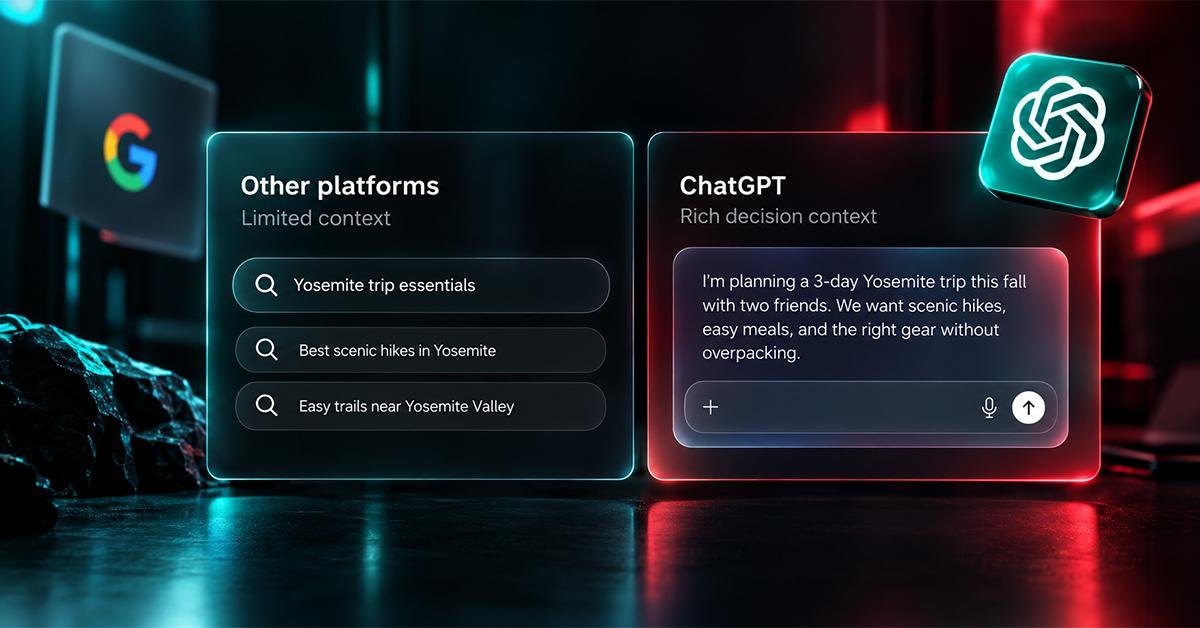
Keywords vs Context: The Big Difference
Imagine someone wants to create a website. On a traditional search engine, they might search: "website development Dubai." That's a relatively straightforward keyword.
But on ChatGPT, they could ask: "I'm starting a jewellery business in Dubai and need an ecommerce website where customers can browse collections, pay online and contact us through WhatsApp. What should I consider before choosing a developer?"
Look at the context contained in that conversation:
Location: Dubai
Industry: Jewellery
Business type: Ecommerce
Requirement: Website development
Features: Online payments + WhatsApp
Intent: Evaluating a website developer
That's why ChatGPT advertising introduces an interesting opportunity. The advertiser isn't simply trying to win a keyword. They're trying to become relevant to a conversation and its underlying intent.
Does ChatGPT Use Keywords for Ads?
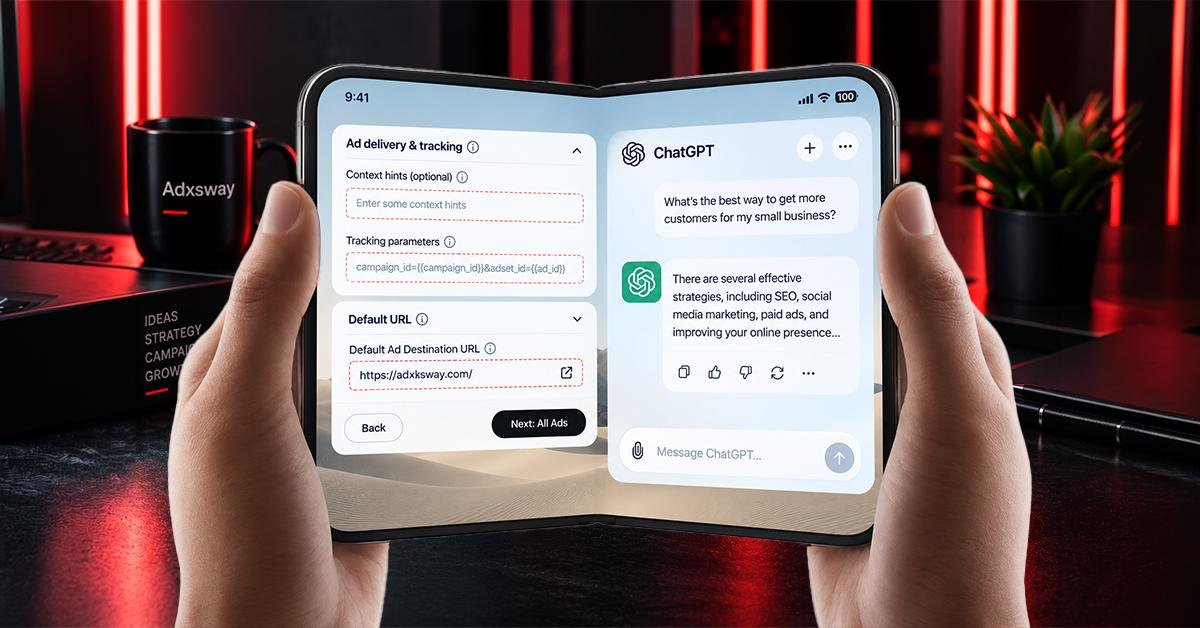
Not exactly in the traditional search-ad sense. ChatGPT Ads supports something called context hints.
Context hints help describe the kinds of conversations, topics, or situations where an advertiser's offer may be relevant.
However, OpenAI specifically explains that these are not exact-match keywords, and providing a context hint does not guarantee that your ad will appear in a particular conversation.
This distinction matters. You shouldn't approach ChatGPT Ads by simply copying your Google Ads keyword list. Instead, think about the situations that happen before someone needs your product or service.
What Are Context Hints in ChatGPT Ads?
Think of context hints as guidance you provide to the advertising system. Suppose you're advertising a social media marketing agency. Instead of focusing only on "social media agency Dubai," you could think about conversations such as:
Struggling to get Instagram leads
Looking for help managing company social media
Trying to create a social media strategy
Deciding whether to hire an agency or in-house marketer
Comparing social media marketing services
These describe contexts where your service could be relevant. That is much closer to how businesses should begin thinking about ChatGPT advertising.
How to Run ChatGPT Ads Step by Step: Account Setup
Go to OpenAI Ads Manager
Start at the official ChatGPT advertising platform, OpenAI Ads Manager (ads.openai.com). Sign in using an OpenAI account associated with your work email or create an appropriate account.
The account setup process currently includes advertiser onboarding, verification, business information and billing/payment setup.
Set Up Your Advertiser Account
Before launching campaigns, configure the advertiser account. You'll need to provide information such as your business name, website, business country/region, currency, time zone and brand logo. You will also need to complete applicable verification and billing requirements.
Be careful when creating the account — OpenAI notes that some account-level settings cannot be changed after creation.
How to Run ChatGPT Ads Step by Step: Build Your Campaign
Understand the ChatGPT Ads Structure
The campaign architecture will feel familiar if you've used Meta Ads. It has three basic levels: Campaign (defines the overall objective, budget, dates and targeting), Ad Group (organizes related ads around a particular theme or intent area — this is also where context hints can help describe conversations relevant to the offer), and Ad (the actual advertisement the user sees).
So: Campaign → Ad Group → Ad. If you've run Meta campaigns before, you can roughly think of it as Campaign → Ad Set → Ad. The mechanics aren't identical, but the hierarchy is easy to understand this way.
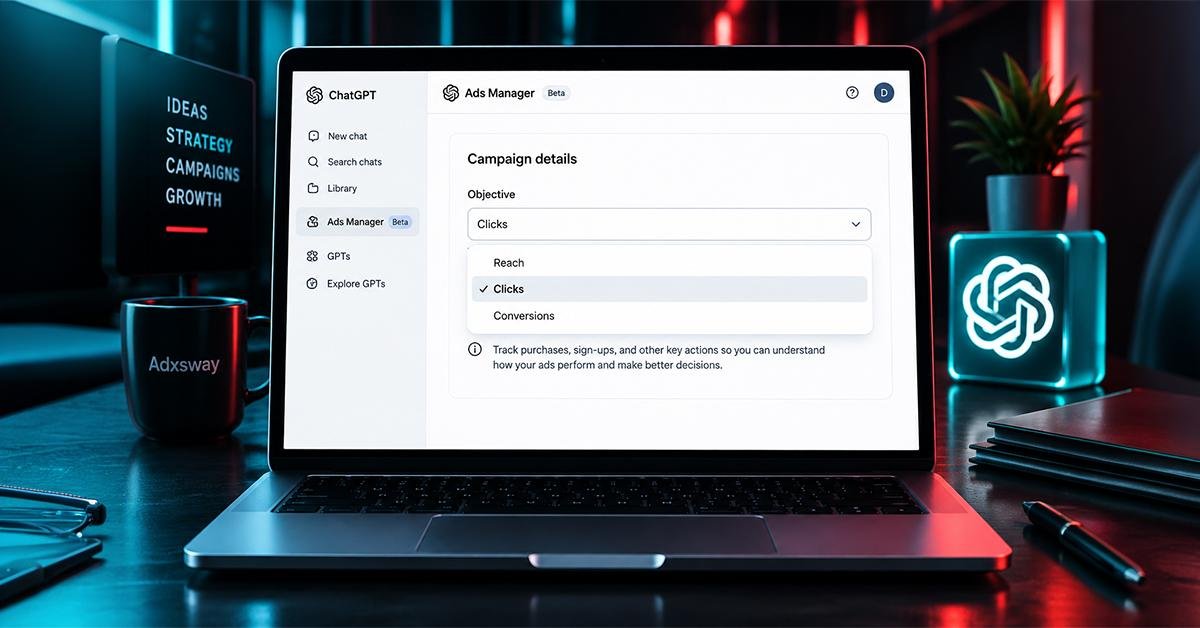
Choose Your Campaign Objective
This is where your business goal becomes important. ChatGPT Ads currently supports three main objectives.
Use Views when your primary objective is visibility. This uses CPM pricing, meaning you're paying based on impressions. Makes sense for brand awareness, product launches, introducing a new company, and increasing visibility.
Choose Clicks when you want people to visit your website or landing page. This uses CPC pricing — you're charged for valid clicks rather than simply paying for impressions. OpenAI currently recommends CPC advertisers consider starting with a maximum bid around $3–$5 USD per click.
Choose Conversions when you want the system to optimize toward a supported conversion event, such as purchases, registrations or other qualified actions. Conversion measurement needs to be configured properly for this objective to be useful.
OpenAI's campaign documentation confirms that campaigns can currently optimize for Views, Clicks or Conversions.
Set Your Campaign Budget
Decide how much you're willing to spend. Your budget should match the purpose of the campaign. If you're testing ChatGPT Ads for the first time, don't evaluate the entire platform from one ad and a tiny amount of data — treat your first campaign as a learning phase.
You're trying to discover which context works, which messaging works, which landing page converts, which creative attracts clicks, and which ad groups generate qualified traffic. That information becomes the foundation for optimization.
Choose Your Target Countries
Campaign setup allows advertisers to choose the countries they want to target. For a Dubai business serving only UAE customers, for example, there would usually be little value in intentionally paying for broad international traffic.
Keep geography aligned with where you can genuinely serve customers. This sounds obvious, but broad targeting is an easy way to waste advertising budget.
How to Run ChatGPT Ads Step by Step: Ad Groups and Context Hints
Create Focused Ad Groups
Don't place every product or service into one ad group. Imagine Adxsway were running a ChatGPT Ads campaign. Instead of one Ad Group called Digital Marketing, we could create separate intent themes:
Social Media Management
Meta Advertising
Website Development
SEO Services
Each ad group can then have its own relevant context hints, ads and landing page. That makes it easier to understand what is actually working.
Write Context Hints
This is one of the areas where ChatGPT Ads requires a different mindset. Don't just ask "What keywords should I target?" Ask "What conversations would happen when someone is likely to need my service?"
For a website development company, relevant contexts could revolve around: starting a new business website, redesigning an outdated website, building an ecommerce store, improving a slow website, choosing between WordPress and custom development, and finding a web development company. These aren't simply keywords — they're customer situations and intentions.
How to Run ChatGPT Ads Step by Step: Write and Test Your Ads
Create Your Advertisement
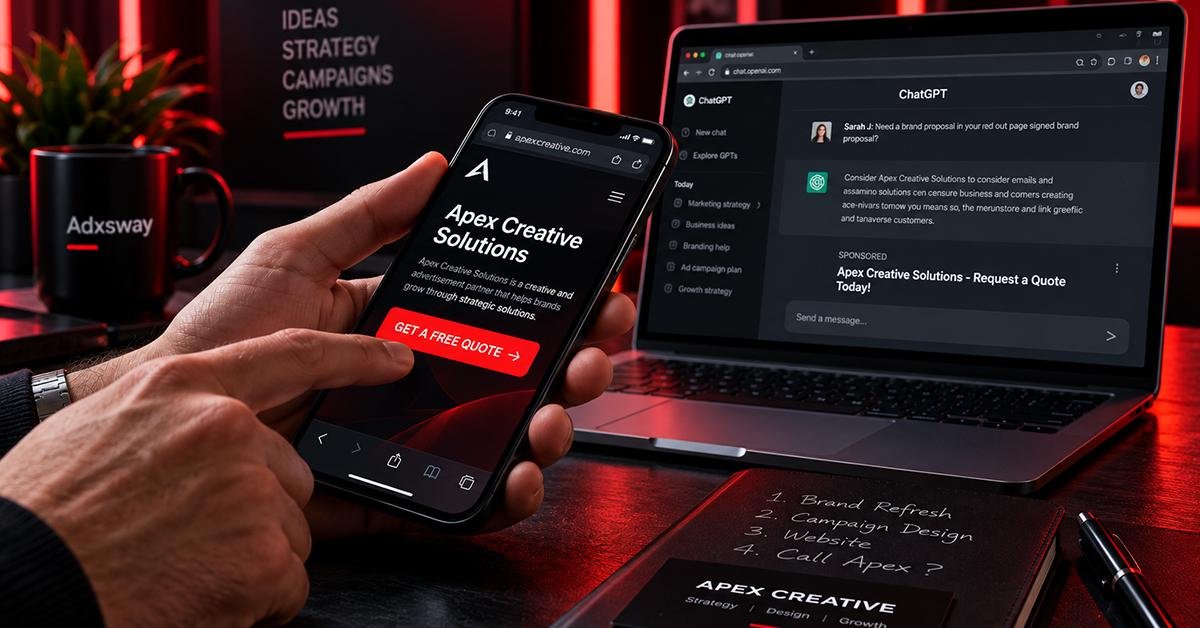
A ChatGPT ad currently includes the core elements mentioned earlier: title, description, image, landing page and advertiser identity. OpenAI recommends clear, specific, benefit-focused messaging rather than vague marketing language, and creating multiple genuinely different title/copy variations rather than repeatedly saying the same thing in slightly different words.
The user may already be deep into a detailed conversation. Your ad doesn't need to scream for attention — it needs to feel useful and relevant at that moment.
Use Multiple Ad Variations
Don't create one ad and assume you've finished. Test different angles. For example, a social media agency might test:
Struggling to generate leads from social media?
Turn your social media presence into a structured growth channel.
Social media strategy, content creation and campaign management.
Social media marketing for UAE businesses.
Each communicates something different. OpenAI explicitly recommends diverse ads because broader creative coverage gives its system more opportunities to match relevant messages to users.
What Does Good ChatGPT Ad Copy Look Like?
Imagine someone is discussing building an ecommerce website. A weak advertisement might say: "Best Digital Agency — Transform your digital presence today!" It sounds like advertising, but it doesn't answer anything specific.
A more useful message might be: "Build Your Ecommerce Website in Dubai — Strategy, UI/UX, development and conversion-focused ecommerce websites for UAE businesses."
Now the user immediately understands what you provide, who it's for, and why it may be relevant. That's closer to OpenAI's current creative guidance: clarity and practical value over generic marketing language.
How to Run ChatGPT Ads Step by Step: Landing Pages, Tracking and Measurement
Build the Right Landing Page
This part shouldn't be ignored. Suppose your advertisement says "Ecommerce Website Development in Dubai" and then sends users to a generic agency homepage covering SEO, branding, social media, video, Google Ads and website development. The connection between ad intent and landing page becomes weaker.
A stronger journey is: conversation about ecommerce website → relevant ChatGPT ad → dedicated ecommerce website development page → portfolio/proof → clear CTA → lead. Relevance needs to continue after the click. OpenAI also lists the landing page itself among the signals its ads system can consider when assessing relevance.
Set Up Conversion Tracking
Clicks don't tell the whole story. Suppose Campaign A gets 100 clicks and Campaign B gets 60 clicks — Campaign A looks better. But what if Campaign A generates 2 leads and Campaign B generates 12 leads? Now Campaign B becomes much more interesting. That's why conversion measurement matters.
OpenAI's current reporting can include impressions, clicks, spend, CTR, average CPC, average CPM and conversions, when appropriate measurement is configured.
Add UTM Tracking
You should also use tracking parameters in your destination URLs, for example: utm_source=chatgpt&utm_medium=paid&utm_campaign=website_development. This lets analytics tools identify traffic coming from your ChatGPT campaigns.
OpenAI confirms that static tracking parameters such as UTMs can be added to landing-page URLs and persist when users click ads — giving your marketing team another way to evaluate traffic quality, sessions, landing-page behaviour, leads, purchases and revenue.
Submit the Campaign for Review
Once your campaign, ad groups and ads are ready, submit them for review. Ads need to comply with OpenAI's advertising policies. If an ad is approved and your account, billing and other requirements are complete, it can begin serving.
If the campaign shows "Not serving," Ads Manager can provide information about the reason. Depending on the issue, advertisers may need to edit/resubmit the campaign or resolve verification, billing or policy issues.
Measure Performance
Once your campaign starts running, don't immediately make decisions from a handful of impressions. Monitor performance and look beyond how many people saw the ad. Evaluate CTR (are people interested enough to click?), CPC (how much are you paying for traffic?), Conversion Rate (are visitors actually taking action?), Cost Per Conversion (how much does a meaningful result cost?), Lead Quality (are these the customers you actually want?) and Revenue (are conversions becoming paying customers?).
Performance marketing should eventually connect advertising spend to business results.
How Does the ChatGPT Ads Auction Work?
OpenAI says ChatGPT Ads uses a relevance-weighted second-price auction among eligible ads. That means bidding matters, but relevance matters too.
This is strategically important. The advertiser willing to throw the most money at an impression isn't necessarily the only consideration. Your landing page, ad message, context, offer and relevance can all matter to delivery.
That's another reason advertisers should resist treating ChatGPT Ads as a simple copy-and-paste version of existing PPC campaigns.
The Biggest Opportunity: Intent Can Be Much Richer
This is where ChatGPT Ads becomes particularly interesting. Someone searching Google for "CRM" could mean almost anything.
Someone telling ChatGPT: "We're a 15-person real estate company and leads are coming from Instagram, WhatsApp and our website. Right now everything is in spreadsheets and salespeople keep forgetting follow-ups. What type of CRM should we use?" has communicated much more.
We know their industry, company size, lead sources, current system, pain point and likely buying intent. That's the strategic promise of conversational advertising: context can reveal why someone needs something, not simply what they're searching for.
That doesn't mean every ChatGPT conversation becomes targetable or that advertisers receive users' conversations. OpenAI says conversations and personal details are not shared with advertisers.
Can ChatGPT Ads Replace Google Ads?
Not necessarily. They address different user behaviours. Google Search Ads are extremely powerful when someone expresses clear search intent. ChatGPT Ads can become useful when someone is researching, understanding, comparing, planning or deciding through conversation.
For many businesses, the smarter question isn't "ChatGPT Ads or Google Ads?" It's "Where does each channel fit within our customer journey?"
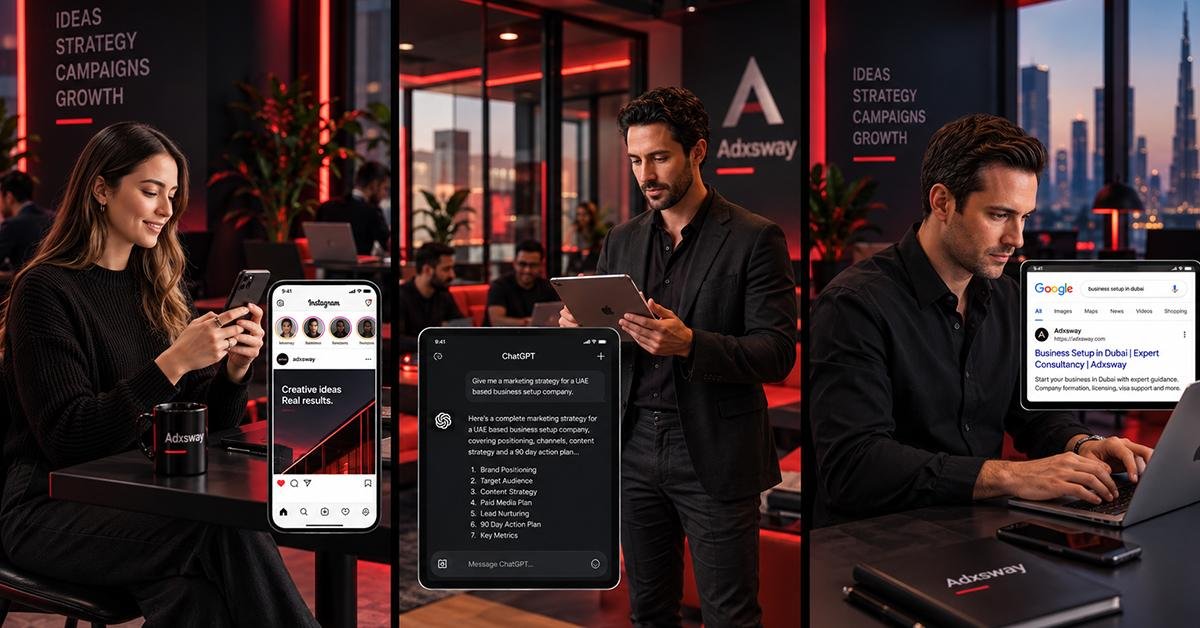
A customer could discover a problem through Instagram, research solutions through ChatGPT, search for providers on Google, visit several websites, see a Meta retargeting ad, and contact one company through WhatsApp. Modern customer journeys aren't linear.
Can ChatGPT Ads Replace Meta Ads?
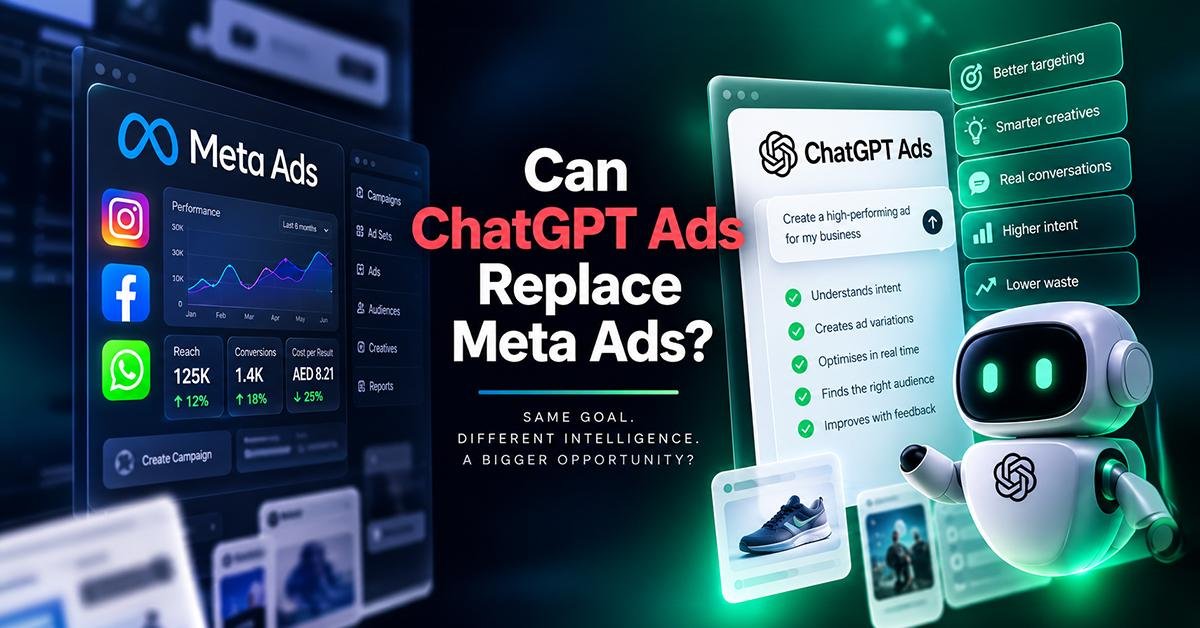
Again, they serve different roles. Meta is exceptionally strong at discovery. Someone doesn't necessarily open Instagram intending to hire an accountant or purchase furniture — an advertisement can create that interest.
ChatGPT interactions can contain more explicit context because users actively explain what they're trying to accomplish.
So a simplified way to think about the channels is: Meta Ads → Discover, Google Search Ads → Search, ChatGPT Ads → Explore, understand, compare and decide.
This is a strategic simplification, not a claim that each platform only performs one function. The strongest advertising strategies will likely use different platforms at different stages of the customer journey.
ChatGPT Ads Are Becoming More AI-Native
The platform is also evolving beyond the initial self-serve Ads Manager. In September 2026, OpenAI announced additional AI advertising capabilities.
Advertisers can now use natural-language prompts with the Ads Manager plugin in ChatGPT to create, update and analyse supported campaigns. OpenAI also introduced AI-assisted creative suggestions inside Ads Manager and optional AI-powered text customization that can adapt existing ad copy to conversational context and translate it to a user's preferred language.
This changes campaign management significantly. Instead of navigating every setting manually, supported workflows can increasingly become conversational — for example, an advertiser could simply say: "Create a campaign for our ecommerce website development service targeting UAE businesses," then review what the system builds before publishing.
The advertiser still remains responsible for reviewing and controlling the campaign.
What Are Sponsored Agents?
This is another development marketers should watch. OpenAI announced testing of Sponsored Agents in September 2026.
The idea goes beyond sending someone from an advertisement directly to a traditional website. After interacting with an ad, a user may be able to begin a conversation with a business-sponsored agent.
Think about the possibilities: a travel company could have an agent helping users explore packages, an ecommerce company could help customers choose between products, a software company could answer product questions, and a service business could help users understand packages before contacting sales.
Advertising could therefore evolve from "See ad → Click → Website" toward "See ad → Start conversation → Explore solution → Take action."
Sponsored Agents are still being tested, so businesses should not treat them as universally available yet.
ChatGPT Ads vs Google Ads vs Meta Ads
| Feature | ChatGPT Ads | Google Search Ads | Meta Ads |
|---|---|---|---|
| Primary environment | Conversation | Search | Social feeds |
| Core opportunity | Context + intent | Search intent | Discovery + audience signals |
| User behaviour | Exploring and deciding | Searching | Browsing/discovering |
| Context depth | Potentially rich conversational context | Primarily query-driven | Platform/audience signals |
| Creative | Title, description, image | Primarily search ad copy | Image/video + copy |
| Paid models | CPM/CPC + conversion optimization | Multiple Google Ads models | Multiple Meta buying models |
| Best strategic use | Research/consideration/decision moments | Existing search demand | Discovery, demand creation & retargeting |
Who Should Test ChatGPT Ads?
The platform may be particularly interesting for businesses where customers typically research before purchasing. For example:
SaaS
Ecommerce
Business services
Marketing agencies
Education
Travel
Home improvement
Technology
Professional services
Complex products
Higher-consideration purchases
The more questions customers ask before purchasing, the more interesting conversational advertising potentially becomes.
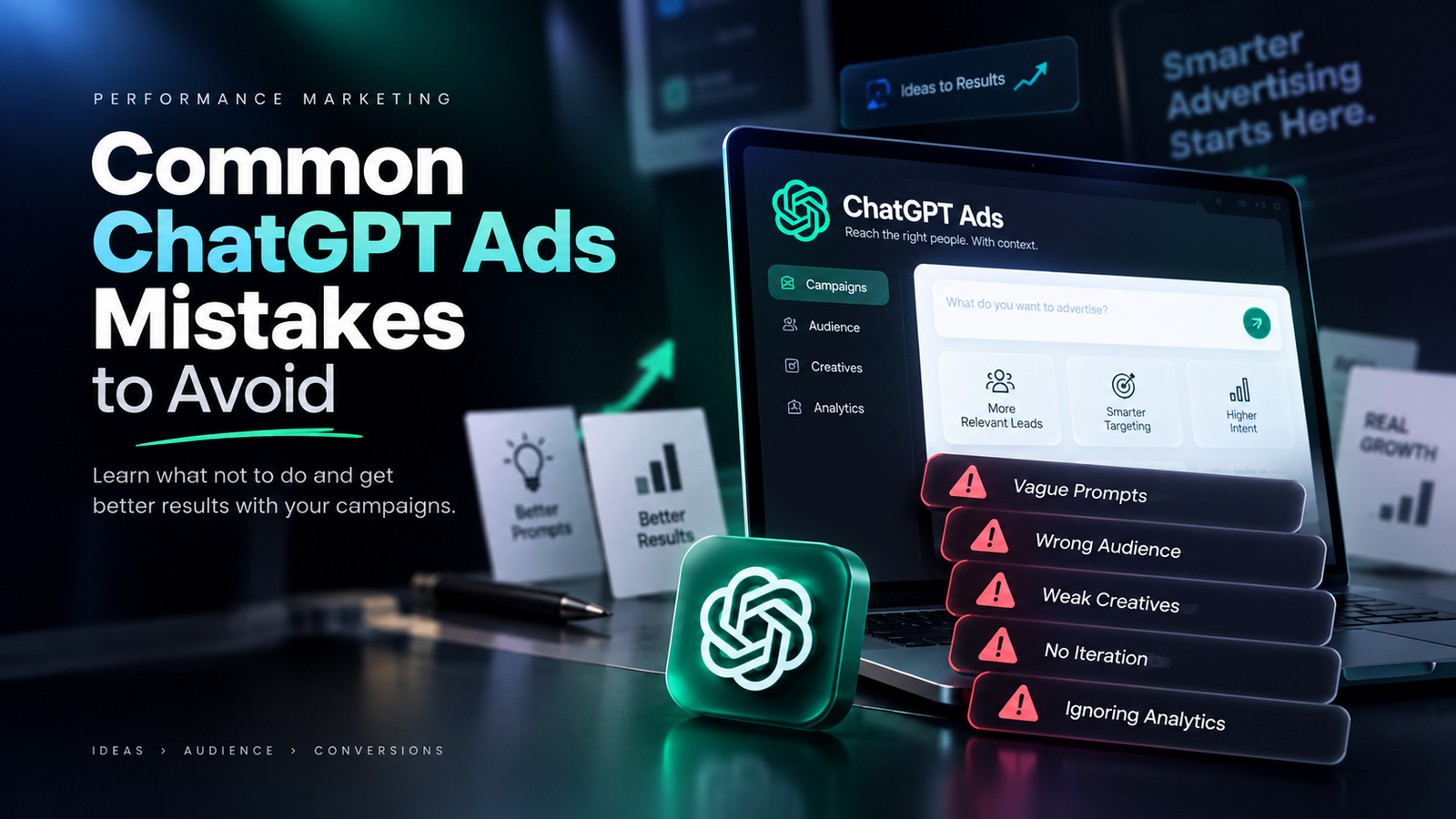
Common ChatGPT Ads Mistakes to Avoid
Copying Your Google Ads Strategy Exactly
ChatGPT isn't simply another keyword search engine. Think about conversational context and customer intent.
Using Generic Ad Copy
"Grow your business today" doesn't tell the user much. Be specific.
Sending Everyone to Your Homepage
Match the landing page to the conversation and offer.
Creating Only One Advertisement
Test multiple meaningful messaging angles.
Optimizing Only for Clicks
Traffic doesn't automatically equal customers. Track conversions and commercial outcomes.
Ignoring Context Hints
They are an important way to communicate when your offer may be relevant.
Making Changes Too Quickly
Give campaigns enough data before drawing conclusions.
Expecting the Platform to Work Exactly Like Meta or Google
It's a different advertising environment. Learn its behaviour rather than forcing an old playbook onto it.
How We Would Structure a First ChatGPT Ads Test
For a service business, a simple first campaign could look like this:
Campaign: Website Development — UAE
Objective: Conversions
Ad Group 1: New Business Websites — Context: People planning or researching a website for a new company.
Ad Group 2: Website Redesign — Context: Businesses discussing outdated, slow or poorly converting websites.
Ad Group 3: Ecommerce Development — Context: Businesses researching online stores, ecommerce platforms and online selling.
Ads: Several different benefit-focused messages for each intent.
Landing Pages: Separate pages aligned with each service.
Measurement: ChatGPT Ads conversion tracking + UTM tracking + CRM lead tracking.
This creates a much cleaner test than throwing every service into one campaign.
The Bigger Shift: From Keywords to Conversations
ChatGPT Ads isn't important simply because another company launched an advertising platform. The bigger change is what happens to intent.
Search advertising taught marketers to understand keywords. Social advertising taught marketers to understand audiences. Conversational advertising may force marketers to understand something deeper: the situation behind the customer's question.
Instead of only asking "What keyword did they type?", marketers may increasingly ask: What are they trying to accomplish? What problem are they solving? What stage of the decision are they in? What information do they need next? How can our brand genuinely help at that moment?
That's a very different advertising mindset. And businesses that understand it early may learn much faster as conversational advertising continues to mature.
Frequently Asked Questions
01What are ChatGPT Ads?
ChatGPT Ads are paid advertisements displayed separately from ChatGPT's answers. Ads can include an advertiser name, title, description, image and destination landing page. OpenAI uses contextual and other eligible signals to determine relevant ad opportunities.
02How do I advertise on ChatGPT?
Businesses can use OpenAI Ads Manager Beta to create an advertiser account, configure billing and verification, create campaigns and ad groups, add context hints, build advertisements, submit them for review and monitor performance.
03Where do I create ChatGPT Ads?
ChatGPT advertising campaigns can be created through the official OpenAI Ads Manager (ads.openai.com).
04How does ChatGPT Ads targeting work?
OpenAI says ad selection can consider conversational context and intent alongside the ad's landing page, title, copy and context hints. Context hints describe relevant conversations or topics but aren't exact-match keywords and don't guarantee placement.
05How much do ChatGPT Ads cost?
Pricing depends on the objective and auction. ChatGPT Ads currently supports impression and valid-click billing. OpenAI's current guidance suggests starting CPC campaigns with a maximum bid around $3–$5 USD per click, although actual costs and competitiveness vary.
06What objectives are available in ChatGPT Ads?
Ads Manager currently supports Views, Clicks and Conversions objectives. Views uses CPM buying, Clicks uses CPC, and Conversions optimizes toward a supported conversion event.
07Are ChatGPT Ads available in the UAE?
OpenAI announced on August 31, 2026 that advertisers could purchase ChatGPT Ads directly through Ads Manager across the Middle East and North Africa, alongside India and Europe. Advertisers should still check current account eligibility and country availability during setup because the beta continues to evolve.
08Do advertisers see people's ChatGPT conversations?
OpenAI states that its expansion of ChatGPT Ads does not involve sharing conversations or personal details with advertisers.
09Do ChatGPT Ads influence ChatGPT's answers?
No. OpenAI says advertisements are separate from ChatGPT's responses and are clearly identified as ads.
10Can ChatGPT create advertising campaigns for me?
OpenAI announced in September 2026 that eligible advertisers can use natural-language prompts with the Ads Manager plugin to create, update and analyse supported campaigns. Advertisers remain in control of reviewing and managing campaign decisions.
Ready to Run Your First ChatGPT Ads Campaign?
Let's build a performance marketing strategy that puts your brand in front of customers wherever they're searching, scrolling or asking questions.
Book A Consultation